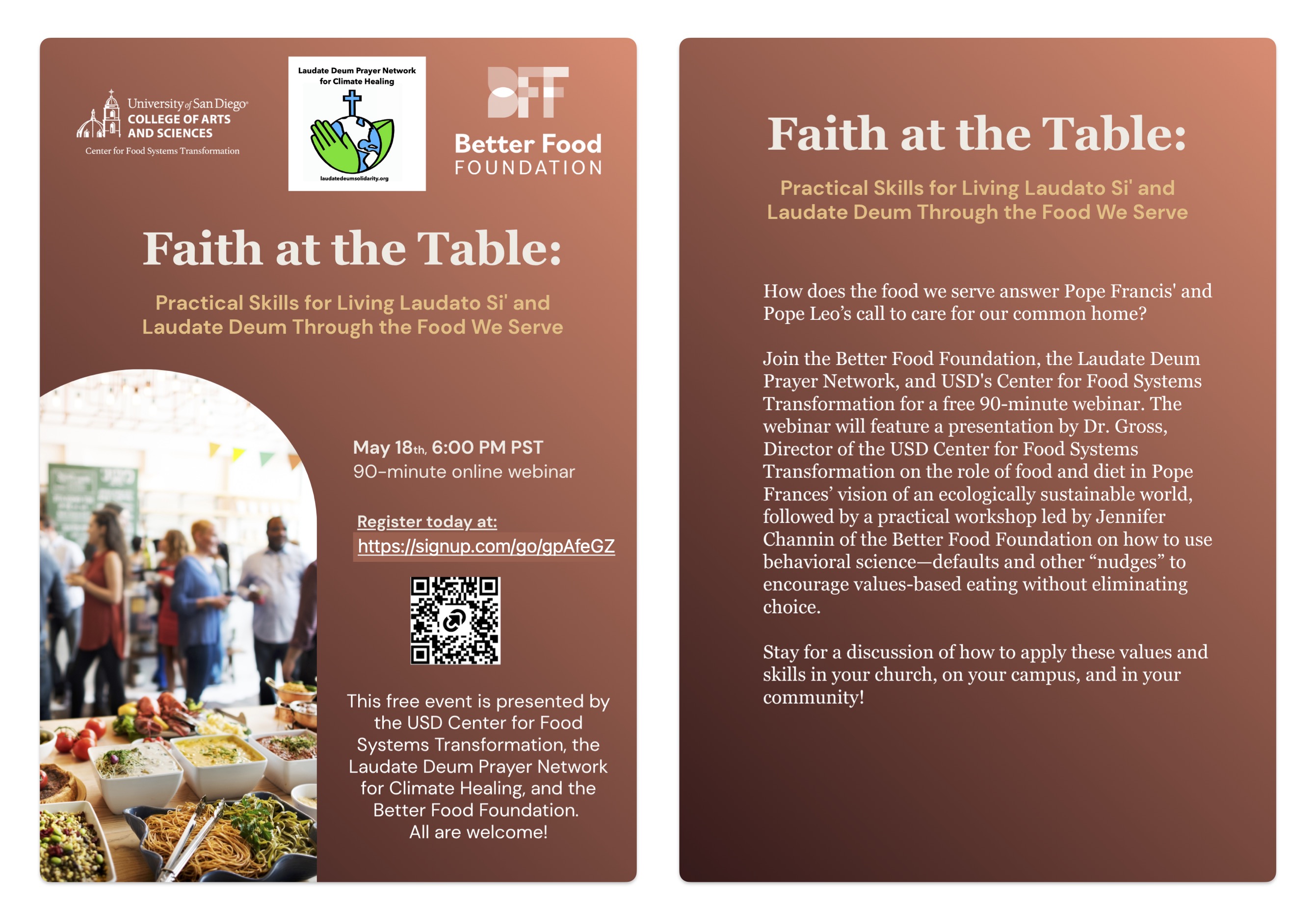
This was a special session about how the food we eat is intimately connected to care for creation, and how we can encourage food choices that are consistent with living the values of Laudato Si’ and Laudate Deum.
Also consider adopting this spiritual practice as a member of the Laudate Deum Prayer Network: Eat in solidarity with the poor and the earth on Thursdays. It is one of the key areas for prayerful actions for climate healing.
If you missed the session, please consider watching here and sharing with your community.
“Pope Francis and now Pope Leo have argued we are at a turning point in our relationship with the natural world. There is a risk that we become, in the words of the Laudato Si’, ‘masters, consumers, ruthless exploiters’ but also the possibility of ‘speaking the language of fraternity and beauty in our relationship to the world.’ One of the most powerful ways we can live out this vision of fraternity is through our food choices” Dr. Aaron Gross
“What if a few small changes to a menu or recipe could significantly reduce green house gas emissions, protect biodiversity, and make your food more inclusive — all without taking away a customer’s options?That’s the power of behavioral science, and in this interactive workshop, you’ll learn how to put it to work in your church and community.” Jennifer Channin
Learn more at the Better Food Foundation and join their Nudge Community.
A particular interest of MarkR, founder of this network, is kidney disease. Check out this easy-to-follow dietary approach for people with kidney disease.
Dr. Aaron Gross is a leading scholar and advocate at the intersection of food, religion, and sustainability. He holds a Bachelor of Arts in Philosophy from Grinnell College, a Master of Theological Studies from Harvard Divinity School, and a Ph.D. in Religious Studies from the University of California, Santa Barbara. He serves as a Professor of Theology and Religious Studies at the University of San Diego and is the founding Director of the University of San Diego’sCenter for Food Systems Transformation, where he works to align institutional food practices with values of justice, compassion, and ecological care.
Dr. Gross is also active in the leadership of the Society for Jewish Ethics and the American Academy of Religion’s Animals and Religion Group and is the founder of Farm Forward, a nonprofit that has partnered with major food companies and universities to dramatically reduce the use of factory-farmed animal products in institutional settings. His work bridges the gap between moral vision and practical action, helping organizations move from stated values to meaningful change in the food they serve.
He is the author of The Question of the Animal and Religion. He brought some of the insights from that book to the big screen while serving as co-writer for the award-winning 2018 documentary, Eating Animals. He has written and spoken widely on how religious traditions—including Catholic social teaching—can and must shape our relationship with food, animals, and the natural world. His work engages directly with the vision articulated in Laudato Si’ and Laudate Deum, treating care for creation not as an abstract ideal but as something expressed concretely at every meal.
Dr. Gross has advised faith communities, universities, and food companies across the country, and is a trusted voice for those seeking to live out their ecological and ethical commitments through the food they choose to serve and eat. Tonight, he brings that expertise to our table—helping us understand how food sits at the very heart of Pope Francis’ call to integral ecology, and what it looks like to answer that call in our daily lives.
Jennifer Channin is the Executive Director of the Better Food Foundation, a non-profit dedicated to transforming the way institutions serve food. Jennifer is also an ordained Unitarian Universalist minister who has served congregations in the USA and Canada. She earned her Masters of Divinity from Harvard Divinity School and BA in International Development from McGill University.
Jennifer has served as the Executive Director of the Better Food Foundation since 2021, where she has become one of the most innovative voices in the food systems movement. Her signature approach draws on behavioral science — specifically the power of defaults and “nudges” — to make values-based eating easier without taking away anyone’s freedom to choose. In universities, hospitals, cafes, religious institutions, conferences and events, the Foundation’s Plant-Based by Default strategy has been effective at reducing food-related carbon emissions. Institutions that have pioneered this strategy include New York City Health + Hospitals, Harvard’s Office of Sustainability, and Sodexo College Dining Services.
Jennifer reminds us that while people tend to think of nature as something “out there,” one of the most important daily interactions we have with the environment is through our meals. That insight is at the heart of her work — and at the heart of tonight’s workshop.
Jennifer is also a contributor to the book The Good It Promises, The Harm It Does: Critical Essays on Effective Altruism, and has partnered with communities across the country to put these strategies into practice. Tonight she brings those tools directly to faith communities, helping us see how small, thoughtful changes in the food we serve can be one of the most powerful ways we live out our call to care for creation.
Leave a Reply